For many families, the campfire is the highlight of camping. The glow, the songs, the stories, and the sticky s’mores are what kids remember most. But a campfire is also one of the most common sources of burns and wildfires on camping trips, and kids move fast, run into things, and often do not understand how dangerous fire can be.
The good news is that campfire safety for kids is mostly about a few clear rules, good setup,p and constant supervision. This guide explains how to build and manage a safe fire, 15 simple rules for children, tips by age, how to roast marshmallows safely, how to put out a fire completely, ly and what to do if someone gets burned. If you are new to camping, start with our first-time family camping guide and our family camping checklist.
Quick answer: how do you keep kids safe around a campfire? Check that fires are allowed, build in a fire ring away from tents and overhanging branches, set a clear “no-go zone” around the fire, keep a bucket of water and a shovel nearby, never leave the fire alone, keep young children within arm’s reach, and put the fire out completely with water by following the rule drown, stir and feel.
Before You Light a Fire: Check the Rules
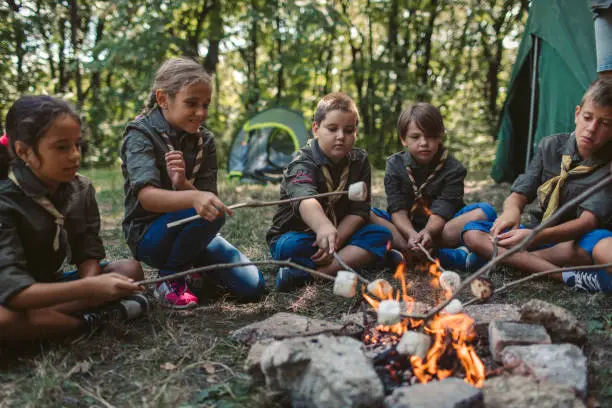
Campfires are not allowed everywhere or all the time. Before you build a fire:
- Check for fire restrictions or bans. Dry, windy, and drought conditions often bring bans. Look at the official page of the campground, park, or forest, or ask a ranger. The National Park Service and local agencies post current fire information.
- Use only designated fire rings or pits where required.
- Check the weather. Do not light a fire in strong wind. The National Weather Service shows wind and fire weather alerts.
- Know the firewood rules. Many areas ask you to buy local firewood to avoid spreading pests, and not to cut live trees.
If fires are banned, you can still enjoy the evening with a camp stove, a lantern, a flashlight, a story, or a battery-powered “campfire” light.
Why Fire Safety Matters So Much
According to the U.S. Forest Service’s Smokey Bear program, nearly nine out of ten wildfires in the U.S. are caused by people. A campfire left unattended or not fully put out can start a fire that destroys homes, forests, and wildlife. Teaching kids to respect fire protects them, your family, and the places you visit.
How to Set Up a Safe Campfire
An adult should build and light the fire. Use these steps.
- Choose a safe spot. Use an existing fire ring if there is one. Keep the fire well away from tents, tarps, vehicles, dry grass, bushes,s and overhanging branches. Many agencies suggest at least 15 feet from tents and anything that can burn, and some campgrounds require more, so check local rules.
- Clear the area. Remove dry leaves, pine needles, twigs, grass, and litter from around the ring.
- Keep the fire small. A small fire is easier to control and enough for cooking and warmth. A fire about as wide as a camp chair is plenty for most families.
- Have water and tools ready. Keep a bucket of water, a shovel,l and, if you have one, a fire extinguisher nearby before you light the first match.
- Use only appropriate fuel. Burn firewood and small kindling. Never use gasoline, lighter fluid in large amounts, or other accelerants, and do not burn trash, plastic,s or foam.
- Light it carefully. Adults should use matches or a long lighter, and keep fuel and lighters away from kids.
- Never leave it alone. A fire should always be watched by an adult.
The “No-Go Zone” Rule
The simplest safety tool for families is a clear boundary around the fire.
- Set a perimeter with camp chairs, logs, gs or a rope about a few steps back from the fire ring.
- Explain it simply: “The space inside the chairs is only for grown-ups.”
- Keep kids behind the line, and seat them on the outside of the circle, not between the chairs and the fire.
- Make the rule fun, like a “magic line” that only adults can cross.
- Do not run, play, or horse around near the fire, even when it is not lit.
Some families also keep a “marshmallow zone,” a place where kids can roast with an adult standing right beside them.
15 Campfire Safety Rules for Kids
Share these rules before you light the fire, and repeat them each evening.
- Only grown-ups light the fire. Kids never touch matches or lighters.
- Stay behind the line. Keep out of the no-go zone.
- No running or playing near the fire.
- Wear shoes at all times. Hot embers burn bare feet.
- Tie back long hair and avoid loose or dangling clothing.
- Do not wear nylon, plastic, or poncho-style jackets near the fire, since they can melt or catch fire.
- Do not throw anything in the fire unless an adult says it is okay. No trash, plastics, aerosol cans, or glass.
- Use long sticks for roasting, and keep the stick pointed down and away from people.
- Do not poke the fire unless an adult is guiding you.
- Tell an adult about flying sparks right away.
- Know “stop, drop,p and roll.” If clothes catch fire, do not run. Stop, drop to the ground, cover your face,ce and roll.
- Never sleep near the fire.
- Do not play with fire in the tent. No candles, lighters, or matches in tents.
- Never leave the fire alone, and tell an adult if you see an unattended fire.
- Help put it out. Always make sure the fire is completely out before bed or leaving camp.
Practice “stop, drop, and roll” together in a safe spot. Kids who have practiced it are more likely to remember it in a scare.
Campfire Safety by Age
Babies and toddlers (0 to 3)
- Keep them well away from the fire, ideally in a carrier or a play area on the far side of camp.
- Stay within arm’s reach at all times, and keep a hand on them when near the fire.
- Keep lighters, matches, hot cookware, and fuel out of reach.
- Remember that toddlers move quickly and can reach hot surfaces in a second. Our guide to camping with toddlers has more safety tips for little ones.
Preschoolers (3 to 5)
- Keep them behind the no-go line, and sit them with an adult.
- Use simple rules: “Hot! Do not touch.”
- Let them help in safe ways, such as gathering kindling away from the fire, with adult help.
- Keep sticks short and supervise marshmallow roasting hand over hand.
School-age kids (6 to 10)
- Teach why fire is dangerous, how it spreads,s and how to put it out.
- Let them practice roasting marshmallows with a long stick, with an adult close by.
- Give jobs like filling the water bucket, but have an adult handle the fire itself.
- Practice stop, drop, op and roll.
Tweens and teens (10 and up)
- Teach fire-building basics and how to put out a fire, always under adult supervision.
- Talk about wildfire risks and why rules and bans matter.
- Give them responsibility, like checking that the fire is out, while an adult confirms.
How to Roast Marshmallows Safely
Roasting marshmallows is the part kids love most, and it causes plenty of burns.
- Use a long roasting stick or a telescoping fork, and not a short twig.
- Hold the marshmallow above the coals, not in open flames. Slow roasting cooks it evenly and keeps kids farther from the fire.
- Keep stick tips pointed down and away from people.
- Let marshmallows cool before eating. Melted marshmallow is extremely hot and sticky, and it can burn skin and mouths.
- Roast one at a time and do not wave sticks around.
- Supervise closely, especially with young children.
- Consider an indoor-safe alternative, such as a stove or a lantern-style “s’mores maker,” on windy or high-risk days.
For more camp food ideas, see our guide to easy camping meals for kids.
What Kids and Adults Should Wear Near a Fire
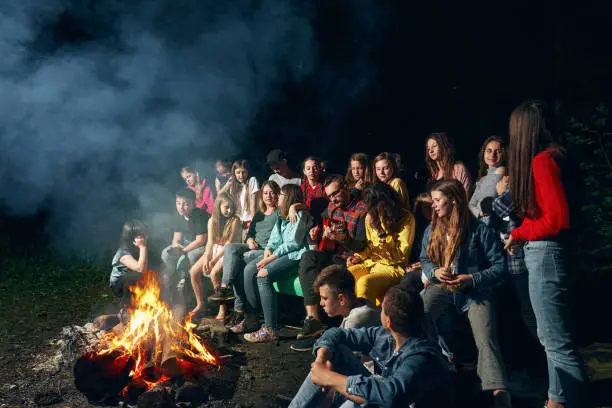
- Closed shoes, not flip-flops or bare feet
- Cotton, wool or other natural fabrics, which are less likely to melt than synthetic clothes
- Tight-fitting sleeves, with loose cuffs rolled or tucked
- No dangling scarves, drawstrings or costumes
- Hair tied back
- No nylon, plastic ponchos or flammable jackets
Wet clothing and rain gear are fine around a fire only if they are not made of material that melts easily. If in doubt, stay farther away.
Common Campfire Hazards to Watch For
- Flying sparks and embers, especially in wind. Move seating upwind and watch for sparks landing on tents, chairs, and clothing.
- Tripping hazards, like logs, chair legs, tent lines, and tools.
- Hot rocks and coals, which stay hot long after the flames are gone.
- Smoke, which can irritate eyes and lungs. Sit upwind, and keep very young children away.
- Tent fires. Never allow fire, candles,s or heaters in or near a tent.
- Axes and wood-cutting. Kids should stay far away from anyone chopping wood.
- Pets. Keep dogs on a leash and away from the fire.
How to Put Out a Campfire Completely
A fire that looks out can still be dangerous. Embers can stay hot for hours and restart in the wind. Follow Smokey Bear’s simple rule: drown, stir,ir and feel.
- Drown. Pour plenty of water over the fire until the hissing stops. Make sure the water reaches all the embers and wood, not just the top.
- Stir. Use a shovel or stick to mix the ashes, wood, and soil so every ember gets wet. Scrape any partly burned sticks.
- Drown again. Add more water as needed.
- Feel. Carefully hold the back of your hand near the ashes. If it feels hot, the fire is not out. Keep adding water and stirring until everything feels cool.
Never bury a fire with dirt, since buried coals can stay hot and restart. Never leave a fire until it is cold. Kids can help with filling the bucket and watching, but an adult should do the stirring and the final check.
If you cannot put out a fire quickly, move people away and call emergency services.
What to Do If Someone Gets Burned
Even with good rules, accidents can happen. Know the basics before you go.
First aid for minor burns
- Cool the burn with cool (not ice-cold) running water for about 10 to 20 minutes.
- Remove rings, watches,s and tight clothing from the burned area before it swells, unless the clothing is stuck to the skin.
- Cover loosely with a clean, dry, non-stick bandage or clean cloth.
- Do not use ice, butter, oils, or home remedies, and do not pop blisters.
- Give age-appropriate pain relief if your doctor has advised it, and watch for signs of infection.
When to get medical help
Call emergency services or get medical care right away if:
- The burn is large, deep,p or looks white, charred, or leathery
- It is on the face, hands, groin,n or over a joint
- It was caused by chemicals or electricity
- The person is a baby or very young child
- There are signs of shock or trouble breathing
- You are unsure how serious it is
The American Academy of Pediatrics’ HealthyChildren.org has detailed burn guidance for parents. Keep a first-aid kit at camp, and see our family travel safety tips for a full list of supplies.
If clothing catches fire
Stop, drop, op and roll. Smother flames with a blanket if one is nearby, then cool the burn and get medical help. Do not let a child run.
Campfire Alternatives for Windy, Dry or No-Fire Days
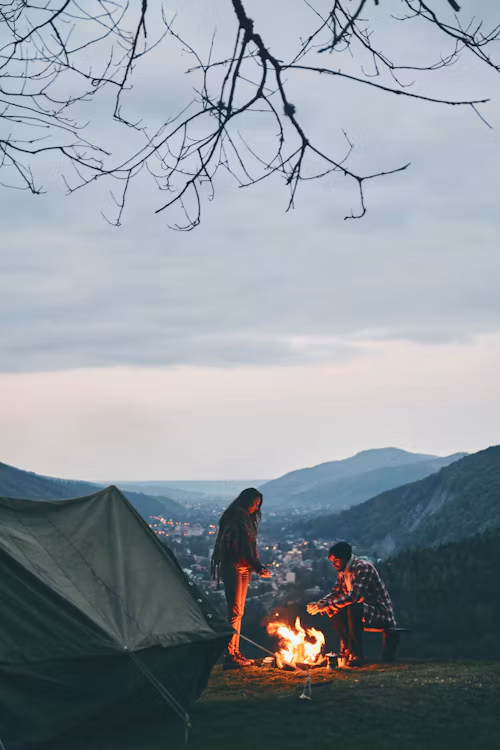
If fires are banned, the weather is poor,oor or you want a lower-risk evening:
- Use a camp stove for cooking and a lantern for light.
- Try a battery-powered or LED “campfire” light for the cozy feeling.
- Make s’mores indoors, with a stove, oven, or microwave at home.
- Tell stories in the tent with flashlights, or play quiet games. See our guide to camping games for kids for ideas.
- Go stargazing with a blanket and a star chart.
Leave No Trace and Campfires
- Use existing fire rings instead of making new ones.
- Keep fires small and use only dead and downed wood where allowed, or local firewood.
- Burn wood completely to ash, and pack out any trash left in the ring.
- Make sure the fire is cold before you leave.
The Leave No Trace Center has guidance on minimizing campfire impacts that families can learn together.
Campfire Safety Checklist
- Fire is allowed, and the weather and wind are safe
- Fire ring is clear of leaves, branches, and tents
- Bucket of water and shovel are in place
- No-go zone is marked with chairs or rope
- Kids have been told the rules
- An adult is assigned as “fire watcher”
- Matches, lighter, and fuel are out of reach
- Kids are wearing shoes and safe clothing
- First-aid kit is nearby
- Fire is drowned, stirred, and felt before bed or leaving
Common Campfire Mistakes
- Letting kids run near the fire. Set the boundary early.
- Leaving the fire unattended, even for a minute.
- Building the fire too big.
- Using accelerants like gasoline or large amounts of lighter fluid.
- Burning trash or plastics.
- Not having water ready.
- Going to bed with a fire that “looks” out.
- Ignoring wind and fire bans.
- Letting kids poke or play with sticks in the fire.
- Wearing loose or synthetic clothing near the flames.
Frequently Asked Questions
How far should kids stay from a campfire?
There is no single number, but set a clear no-go zone a few steps back from the fire ring, mark it with chairs or rope, keep toddlers within arm’s reach, and make sure no one gets close without an adult. Follow any specific distance rules at your campground.
At what age can kids help with a campfire?
Young kids can help in safe ways, like gathering small kindling away from the fire or filling a water bucket. Older children can learn fire-building and putting out fires, but an adult should supervise throughout and handle lighting.
How do you put out a campfire with kids?
Use “drown,sti r stir,d feel.” Pour water on the fire, stir the ashes and wood, add more water, and check that everything feels cool. Let kids help with the bucket, but have an adult do the stirring and final check.
Is it safe to sleep near a campfire?
No. Keep sleeping areas well away from the fire, and never fall asleep with a fire burning. Embers can restart it, and sparks can land on tents and sleeping bags.
Can toddlers be near a campfire?
Toddlers should stay well away or be held or carried by an adult. They move quickly and do not understand danger, so stay within arm’s reach and keep the fire area clear.
What should kids not wear around a campfire?
Avoid loose clothing, dangling scarves, nylon or plastic jackets, and flip-flops. Wear closed shoes and tie back long hair.
What do you do if a child touches hot embers or a hot rock?
Cool the area with cool running water for 10 to 20 minutes, cover loosely with a clean bandage, and get medical help if the burn is large, deep, blistering,g or on the hands, face,ce or feet.
Final Thoughts
A campfire does not have to be dangerous to be magical. With clear rules, a marked boundary, a water bucket at hand and an adult watching, you can enjoy the stories, songs and s’mores with much less worry. Teach kids why fire matters, practice what to do in an emergency,ncy and always put the fire out completely. Safe habits at the campfire are habits that last.
Ready for more? Read our first-time family camping guide, or browse the best family vacations in the U.S. for destinations with great campgrounds.
Pingback: Free Things to Do in National Parks With Kids (30 Ideas)