Winter turns familiar trails into something new. Snow muffles sound, frosted branches sparkle, waterfalls freeze into sculptures, and kids can follow animal tracks that vanish in summer. Many families find that winter hiking with kids becomes one of their favorite seasons, as long as everyone stays warm, dry, fed, and flexible.
The difference between a magical winter hike and a miserable one almost always comes down to preparation. This guide covers what to wear by temperature, how far to go, which trails to choose, what to pack, how to spot cold injuries early, how to keep kids happy, and how to handle babies and toddlers. If you are new to hiking with children overall, start with our beginner’s guide to hiking with kids.
Quick answer: how do you hike with kids in winter? Plan for about half the distance your kids cover in summer, dress them in moisture-wicking layers with a waterproof shell and mittens, wear insulated waterproof boots, bring hot drinks and calorie-rich snacks, choose a short and well-marked trail with a fun destination, start early to use the daylight, and turn around at the first signs of cold, wetness or tiredness.
Is Winter Hiking Safe for Kids?
Yes, when you plan for the conditions. Kids lose heat faster than adults; they may not tell you they are cold until they are very cold, and wet clothing makes everything worse. Shorter days, icy surfaces, and changing weather add more risks. Handle those, and winter hikes can be just as safe as summer ones.
Always check the forecast on the National Weather Service, and look at the official park page on nps.gov for closures, snow conditions, and alerts. Do not rely only on the temperature. Wind, wetness,s and sun all change how cold it feels.
The Half-Distance Rule
Winter hiking is harder than summer hiking. Snow, ice, heavy boots and bulky clothes all slow kids down and use more energy. A simple rule many families use is to plan about half the distance your child hikes comfortably in summer. If your child can walk three miles in warm weather, a winter hike of about one and a half miles is a sensible target.
Also plan more time than you think. Stops to add layers, eat, warm up, and play in the snow are part of the day, and they are what make winter hikes fun.
How Cold Is Too Cold?
There is no official number that works for every child, trail and day. Wind chill, wetness, sunshine, the child’s age, and how active they are all matter. As a rule of thumb:
- Many families choose short outings near the car when temperatures are around freezing or colder, and skip the trail when it is bitterly cold or windy.
- Very young children and babies are more vulnerable, so be more cautious and ask your pediatrician for advice.
- Stay home during blizzards, freezing rain, dangerous wind chills, or icy conditions.
- If your child is wet, tired,d or hungry, they will get cold faster, so tighten your plans.
When in doubt, choose a shorter hike or a different day. A cancelled hike costs nothing, and a cold child costs the whole trip.
What Kids Should Wear: Layers by Temperature
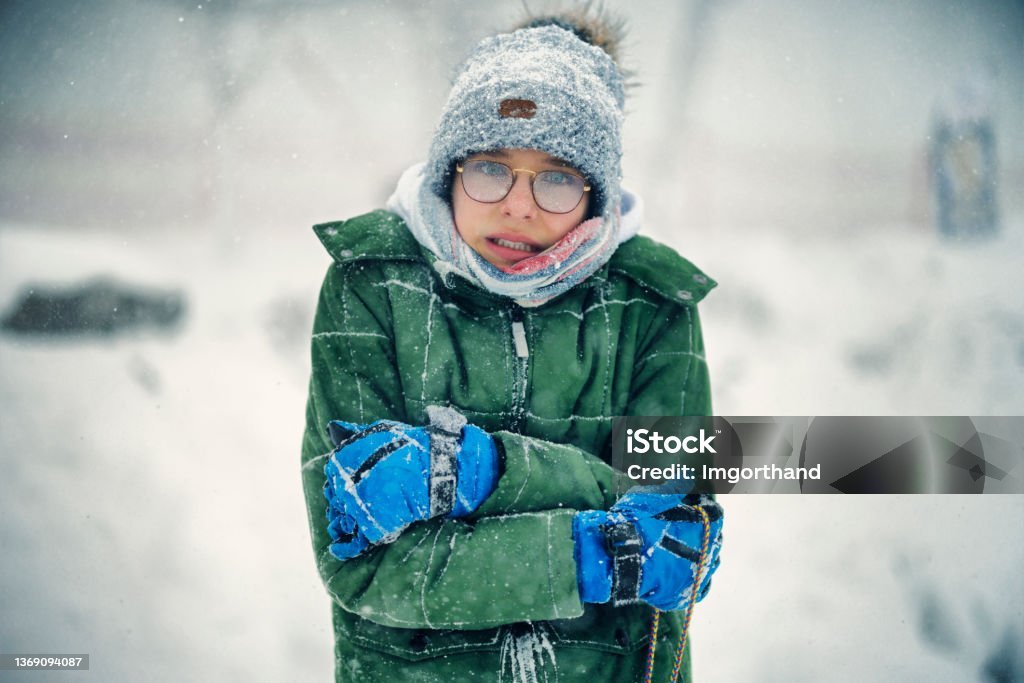
Shot with Canon R5.
The secret is layers. Layers trap warm air and let you remove or add clothing as kids heat up or cool down. Many outdoor families call this the “onion” system.
The three main layers
- Base layer: a thin, snug, moisture-wicking layer such as synthetic or wool leggings and a long-sleeve top. Avoid cotton, which holds moisture and chills kids quickly.
- Middle layer: fleece or an insulated jacket for warmth. A zip-up style is easier to take off than a pullover when kids get hot.
- Outer layer: a waterproof, windproof jacket and snow pants or shell pants. Bright colors help you see kids in the snow.
Hands, head and neck
- Warm hat that covers the ears
- Mittens (generally warmer than gloves for young children), ideally with long cuffs that stay over jacket sleeves
- Neck gaiter or fleece neck warmer (avoid long loose scarves that can snag or choke)
- Sunglasses or goggles, since snow glare is strong
Feet
- Insulated, waterproof boots with good grip, sized with room for warm socks. See our guide to hiking shoes for kids for fit tips.
- Wool or synthetic socks, plus at least one spare pair
- Make sure boots are not too tight, because tight boots restrict circulation and make feet colder
A temperature guide (general only)
Use this as a starting point, then adjust for wind, sun and your child.
| Conditions | What to wear |
|---|---|
| Cool, 40 to 50°F (4 to 10°C) | Base layer, fleece, light shell, hat and light gloves |
| Cold, 30 to 40°F (-1 to 4°C) | Base layer, fleece or insulated jacket, waterproof shell or rain pants, warm hat, gloves or mittens |
| Freezing, 20 to 30°F (-7 to -1°C) | Base layer, fleece, insulated jacket and shell, snow pants, hat, mittens, neck warmer, insulated boots |
| Very cold, below 20°F (-7°C) | All of the above plus an extra mid layer, spare mittens and hat, hand warmers, and a short outing close to the car |
Wet snow and rain call for waterproof outer layers even when temperatures are above freezing. Our guide to hiking in the rain with kids explains how to handle wet conditions.
Dress for the start, not the finish
Kids warm up quickly once they start moving. Dress them so they feel slightly cool at the trailhead, then add or remove layers as needed. Sweating under thick layers leads to chills later, so stop and unzip or remove a layer before kids get sweaty.
What to Pack for a Winter Hike
Winter makes small items matter more. Our guide to the best travel gear for kids covers general gear, and here is a winter-focused list.
Warmth and dry gear
- Spare mittens, hat, and socks for each child
- An extra warm layer, such as a fleece or a light puffy jacket
- A full change of clothes in the car
- A waterproof bag for wet items
Food and drink
- Insulated bottles and a thermos of hot chocolate, warm juice, or herbal tea (test the temperature so it is not too hot for children)
- Calorie-rich snacks, since kids burn more energy staying warm: granola bars, cheese, crackers, dried fruit, trail mix (avoid whole nuts for toddlers) and a few sweet treats
- Water, because kids can get dehydrated in the cold even when they do not feel thirsty
Comfort and safety
- Hand and toe warmers (keep them in mittens or boots, not directly against a young child’s skin)
- An insulated sit pad or small foam pad, because sitting on cold snow, ice or rock chills kids quickly
- Headlamp, whistle, first-aid kit, and any prescribed medicines
- Emergency blanket
- Sunscreen and lip balm, since snow reflects the sun
- A charged phone kept warm in an inside pocket, plus a map or offline navigation
- A trash bag to pack out all trash
Choosing the Right Winter Trail
Winter changes how trails behave. Choose with extra care.
- Short and gentle. Aim for shorter distances and little elevation gain, since climbing in snow is hard work.
- Well-marked and popular. In snow, trails are harder to follow, and a packed path is easier to walk on. If you are new to winter hiking, choose a trail you already know or one that is groomed or widely used.
- Low elevation. Higher areas are colder, windier,r and snowier.
- A fun destination. Kids walk farther when there is something to reach, such as a frozen waterfall, a river overlook, an icy creek or a viewpoint.
- Check conditions. Trails can be icy, buried in snow, closed, ed or covered in ice at trailheads. Look for recent reports.
- Avoid avalanche terrain. Avalanches most often happen on steep slopes, roughly between 30 and 45 degrees, and in the paths below them. Stay on flat or gently rolling routes, and check local avalanche information on sites such as Avalanche.org if you will be in mountain areas.
- Stay off frozen water. Do not let kids walk on frozen lakes, ponds or streams. Ice thickness is unpredictable.
Trail ideas that work well in winter
- Riverside and creekside paths, where kids can watch ice and flowing water
- Frozen waterfall walks, with safe viewing areas away from the base and steep ice
- Forest loops that shelter you from wind
- Winter wildlife viewing at refuges and wetlands, where birds such as geese and swans may gather.
- Mild coastal walks, where winter can be pleasant, but waves and wind need respect.
- Nature center trails, often cleared and easier to follow
Our list of family friendly hikes in the U.S. and our guide to family-friendly mountain getaways can help you find places to start, but conditions change quickly in winter, so check the official page before every trip.
Traction, Snowshoes, Sleds and Skis
- Traction devices that slip over boots (often called microspikes) help on packed snow and ice.
- Snowshoes let you walk on deep snow, and kids’ sizes are available. Rentals are common at many winter areas.
- Poles help adults and older kids balance.
- Sleds can be a fun way to bring a tired toddler along on a flat, packed trail, but keep children secured, bundled,d and supervised, and avoid steep slopes and roads.
Practice with any equipment on a flat area before heading out.
Winter Safety: Cold Injuries, Daylight and Weather
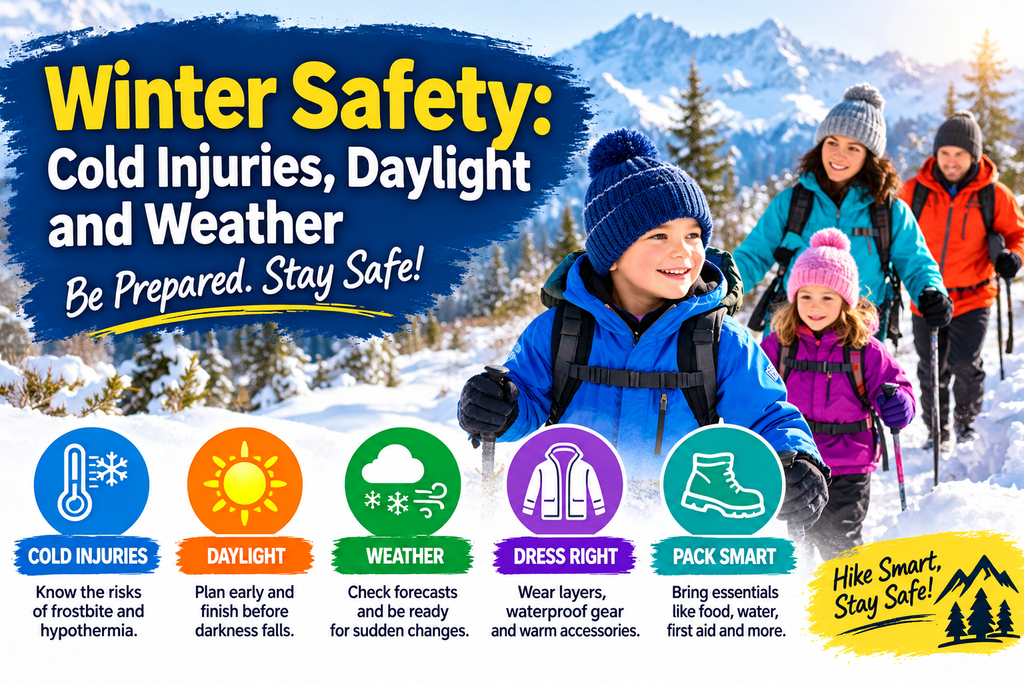
Our family travel safety tips cover general trail safety. In winter, add these.
Hypothermia
Hypothermia happens when the body loses heat faster than it can produce it. Watch for:
- Shivering that gets stronger, or shivering that stops
- Slurred speech, confusion, or clumsiness
- Unusual sleepiness, quietness,nes,s or crankiness
- Pale or cold skin
If you see these signs, get the child out of the wind, replace wet clothing with dry layers, wrap them in blankets, offer a warm drink if they are alert, and seek medical help if symptoms are serious.
Frostbite
Frostbite affects skin and tissue, often on fingers, toes, ears, nose,e and cheeks. Look for:
- Numbness or tingling
- Skin that looks pale, waxy, or gray
- Hard or stiff skin
If you suspect frostbite, get indoors, gently warm the area with warm (not hot) water or body heat, do not rub the skin,n and seek medical help. The American Academy of Pediatrics’ HealthyChildren.org offers guidance on keeping children safe in cold weather.
Overheating and sweating
Overdressing is a real risk. A sweaty child will get chilled when they stop. If kids are flushed or sweating, remove a layer.
Teach kids to tell you.
Give children simple jobs: wiggle your toes, check your fingers, and tell me if you are cold, wet,t or hungry. Check them every 15 to 20 minutes by feeling the back of the neck and looking at hands, feet, and faces. Kids who feel part of the plan speak up sooner.
Plan your daylight
Winter days are short, often only about eight or nine hours of daylight in much of the northern U.S. and less farther north. Check sunrise and sunset times, start early, carry a headlamp and set a firm turnaround time.
Weather and wind
Wind chill makes it feel colder than the air temperature, so check the wind forecast and avoid exposed ridges. Weather can change fast. If conditions worsen or kids are unhappy, turn around.
Winter driving and the trailhead
- Check road conditions and carry traction aids, a blanket, water, snacks, and a small shovel in the car.
- Keep your gas tank at least half full.
- Expect icy trailhead parking, and give yourself extra time.
- Leave a plan with someone, since help can take longer to arrive in snowy conditions.
Keeping Kids Happy in the Cold
A cold child is a cranky child. These ideas keep morale high.
- Keep moving, with short breaks. Several short breaks beat a long one, because kids cool down quickly when they stop.
- Snack often. Food fuels warmth.
- Serve something hot. A thermos of hot chocolate at the turnaround spot gives kids something to look forward to.
- Set mini goals. “Let’s reach the frozen creek, then have a snack.”
- Let kids play in the snow. Do not worry too much about a little snow on their clothes, as long as they stay warm and you have dry layers.
- Choose a hike with a payoff, such as icicles, a frozen waterfall,l or a river view.
- Let them lead for part of the trail.
- Plan a reward, like a warm lunch or a hot bath afterward.
Winter trail games
| Game | How it works |
|---|---|
| Animal track detectives | Look for tracks, droppings, gs and nests, and guess who made them |
| Winter bingo | Cards with pinecones, icicles, tracks, birds and evergreens |
| Look for the alphabet | Search for shapes of letters in branches and snowdrifts |
| Snow safari | Pretend to track a moose, elk or snow leopard |
| Treasure hunt | Hide small treats on rocks or stumps for kids to find |
| Bird count | Count chickadees, cardinals and other winter birds |
| Photo challenge | Let older kids capture frost,i ce,e and shadows |
| Snow art | Make snow angels, snowmen or snow sculptures at breaks |
For more ideas that work on any trail, see our guide to how to get kids to like hiking.
Winter Hiking With Babies and Toddlers
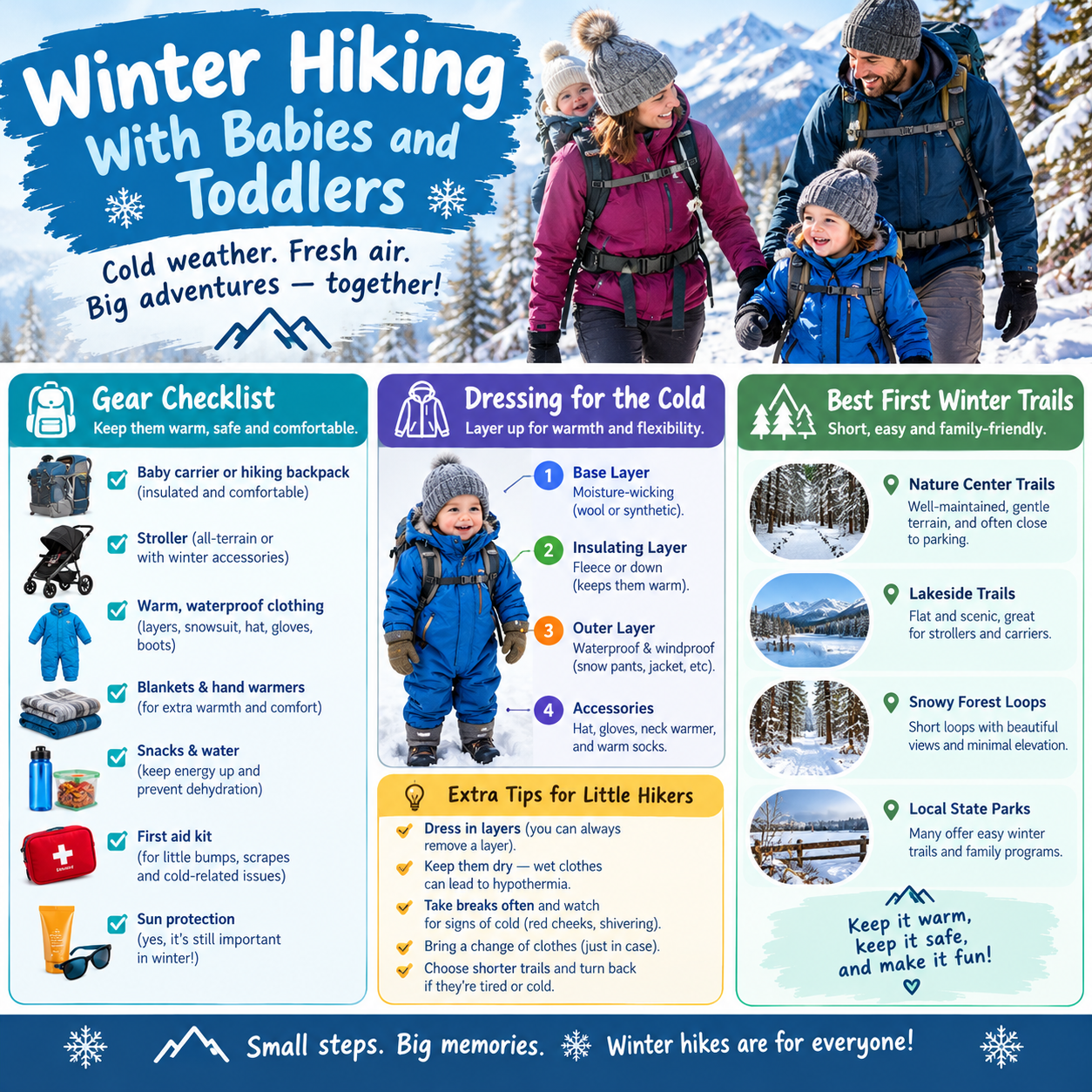
Little ones need extra care in the cold. Our guides to hiking with a baby and hiking with toddlers go into more detail, and here are the winter essentials.
Babies
- Check with your pediatrician before taking a baby out in very cold weather.
- Dress in layers that suit the carrier. Avoid bulky snowsuits that interfere with a safe fit, and use a wind-resistant outer layer or a carrier cover.
- Check often by feeling the back of the neck and chest, and look at hands, feet, et and face.
- Watch for overheating, since carriers add body heat and many parents overdress babies at first.
- Plan feeding stops in a sheltered, warm spot. Keep bottles and formula from freezing by using insulated pouches, and keep breast milk safe and warm.
- Keep it short, and have a warm car and dry clothes ready.
Toddlers
- Mittens with long cuffs stay on small hands better than gloves.
- Plan very short walks and a way to carry or pull them when they tire.
- Keep them dry. Pack extra clothes, since toddlers love to flop in the snow.
- Use a sled on a flat, packed trail if you want an easy way to bring them along, with supervision.
Leave No Trace in Winter
Snow does not hide your impact. Pack out all trash, including food scraps, and stay on the trail where it is visible. Avoid trampling plants under thin snow, and give wildlife plenty of space, since animals have less food and energy in winter. The Leave No Trace Center has guidance for winter recreation.
A Sample Winter Hike Timeline
This is an example for a one-mile winter hike with school-age kids. Adjust it for your family.
| Time | What happens |
|---|---|
| 10:00 | Arrive, bathroom stop, check layers and boots |
| 10:15 | Start walking; ng, kids are slightly cool at the start |
| 10:45 | Snack and hot drink break on the sit pads |
| 11:15 | Play in the snow, look for tracks |
| 11:45 | Head back, add or remove layers as needed |
| 12:30 | Back at the car, dry clothes and a warm lunch |
Notice how much time is spent on breaks and play. That keeps kids warm and happy.
Winter Hiking Checklist
- Forecast, wind, and trail conditions checked
- Layers, mittens, hat and neck warmer on every child
- Insulated waterproof boots and wool or synthetic socks
- Spare mittens, hat, socks and a dry change in the car
- Hot drink, water and calorie-rich snacks
- Sit pad, hand warmers, headlamp and first-aid kit
- Sunscreen, lip balm and sunglasses or goggles
- Traction devices or snowshoes if needed
- Route and return time shared with someone
- Firm turnaround time set
Common Mistakes in Winter Hiking With Kids
- Wearing cotton. It stays wet and makes kids cold.
- Overdressing at the start. Sweat leads to chills.
- Planning too far. Remember the half-distance rule.
- Skipping spare clothes and mittens. Wet hands end hikes fast.
- Forgetting snacks and warm drinks. Cold kids get hungry fast.
- Sitting on snow. Use a sit pad.
- Starting late. Winter daylight is short.
- Ignoring signs of cold. Check children often.
- Walking on frozen water. Stay off ice.
- Choosing a trail you do not know for a first winter hike with kids.
Frequently Asked Questions
Is it okay to take kids hiking in the winter?
Yes, with the right clothing, gear, and planning. Choose short, safe trails, dress in warm layers, watch for signs of cold and turn back if conditions change.
What should kids wear for winter hiking?
Moisture-wicking base layers, a fleece or insulated middle layer, a waterproof and windproof outer layer, a warm hat, mittens, a neck warmer, insulated waterproof boots, and warm socks. Pack spare mittens and socks.
How far should kids hike in winter?
About half of what they can do in summer is a good starting point. A child who hikes three miles in warm weather may be happy with about one and a half in the snow.
How cold is too cold for kids to hike?
There is no single number. Wind chill, wetness, the child’s age,e and activity level all matter. Check the forecast, avoid dangerous wind chills, and stay home if it is bitterly cold or stormy. Ask your pediatrician for advice about very young children.
What is the best way to keep kids’ hands and feet warm?
Use mittens instead of gloves, wool or synthetic socks, insulated boots that are not too tight, and spare pairs. Keep kids moving, and use warmers carefully in mittens or boots.
Do kids need snowshoes or traction devices?
Not always. On packed snow and ice, traction devices help. On deep, unpacked snow, snowshoes make walking easier. Choose a trail that matches your gear and your kids’ ability.
Can I take a baby winter hiking?
It depends on the weather, the baby’s age,ge and your pediatrician’s advice. If you go, keep it short, dress the baby in layers that suit the carrier, and check them often.
Should kids wear sunscreen in winter?
Yes, on bright days, especially around snow, which reflects sunlight. Use sunscreen and lip balm, and sunglasses or goggles to protect eyes.
What are good winter hikes for families?
Short, well-marked trails with a reward, such as a frozen waterfall, a river overlook, a forest loop, or a wildlife refuge boardwalk. Always check current conditions first.
Final Thoughts
Winter hiking with kids is about dressing well, planning less distance, and enjoying the snowy quiet. Pack warm drinks, bring a sit pad, choose a short trail with a payoff, check on your kids often and turn back when it stops being fun. Done right, a winter hike becomes the kind of adventure kids remember for years.
Ready for more? Our guide to backpacking with kids shows how to plan longer trips when the weather warms, our article on adventure activities that are safe for kids shares other ways to enjoy the cold season, and our roundup of the best family vacations in the U.S. has places to explore all year.