The best mountains in the US range from glacier-wrapped giants in Alaska to misty, forested ridges in Tennessee and North Carolina. Some are famous for climbing, some for scenic drives, and some are simply places where a family can stand on a ridge, breathe cool air, and feel small in the best possible way. The problem is choosing, because the country has far more mountains than any single trip can cover.

This guide makes that choice easier. It covers seven major mountain ranges and 23 iconic peaks and mountain destinations, grouped by region, with notes on what makes each one special, how people usually experience it,t and when to go. Whether you want an easy viewpoint, a family-friendly national park or a serious summit goal, you will find a good starting point below.
Quick answer: what are the best mountains in the US? Denali (Alaska), Mount Rainier (Washington), Mount Whitney (California), the Grand Teton (Wyoming), Longs Peak (Colorado), the Great Smoky Mountains (Tennessee and North Carolina) and Mount Washington (New Hampshire) are among the most famous and rewarding. For scenery without a hard climb, look at Glacier National Park, Rocky Mountain National Park and the Smokies.
Best Mountains in the US at a Glance
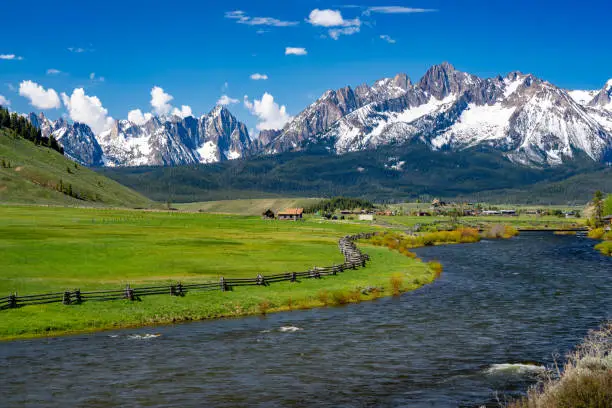
If you only want a fast answer, use this list to match a mountain to your goal:
- Highest peak in the US: Denali, Alaska, at about 20,310 feet
- Highest peak in the lower 48: Mount Whitney, California, at about 14,505 feet
- Most famous alpine skyline: the Grand Teton, Wyoming
- Best mountain park for families: Great Smoky Mountains National Park or Rocky Mountain National Park
- Best scenic drive: Going-to-the-Sun Road in Glacier National Park
- Best for wildflowers: Mount Rainier, Washington, in midsummer
- Best volcano story: Mount Saint Helens, Washington
- Best for extreme weather: Mount Washington, New Hampshire
- Tallest mountain from base to summit: Mauna Kea, Hawaii
- Best for easy summit views: Pikes Peak, Colorado, and Mount Mitchell, North Carolina
Elevations in this guide are rounded and can differ slightly between sources, so check the official park or land manager page before you travel.
7 Best Mountain Ranges in the US
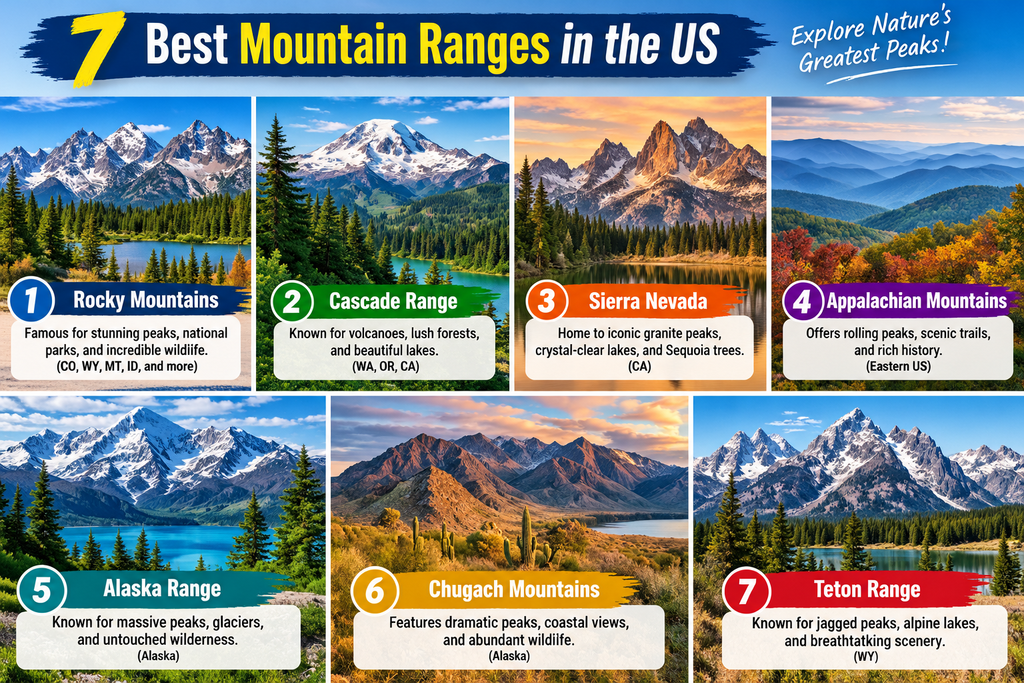
A range is often the better way to plan a trip, because one region can hold parks, trails, scenic roads, and small towns within a few hours of each other.
1. The Rocky Mountains
The Rockies run roughly 3,000 miles from Canada down to New Mexico, which makes them one of the largest mountain systems in North America. Colorado holds many of the best-known pieces, including Rocky Mountain National Park and the Front Range. If you only have a week, base yourself in Estes Park, drive Trail Ridge Road when it is open, and add short alpine walks. Many travelers also add Yellowstone and Grand Teton for a northern Rockies trip.
2. The Appalachian Mountains
The Appalachians stretch from Maine toward Alabama and include the White Mountains, the Blue Ridge and the Great Smokies, plus many quiet ridges and valleys between them. These are older, lower,r and greener than the western ranges, so they suit travelers who want forests, waterfalls, fall color,lor and gentler trails.
3. The Great Smoky Mountains
The Smokies straddle the Tennessee and North Carolina border and are part of the Appalachians. The national park is the most visited in the country, and it protects one of the largest areas of old-growth forest in the eastern US. Low clouds often hang over the ridges, which gives the range its name and its soft, layered look at sunrise. See the National Park Service page for the park for current road and trail information.
4. The Alaska Range
The Alaska Range is a relatively narrow band of very big mountains, and it includes Denali, the tallest peak in North America. The area is cold, remote, mote and glaciated, so most visitors enjoy it from park buses, short trails,s and scenic flights rather than climbing. Denali National Park also offers wildlife viewing, including grizzly bears, moose and caribou.
5. The Sierra Nevada
The Sierra Nevada in California packs a lot into a compact area: Yosemite, Sequoia and Kings Canyon National Parks, Lake Tahoe, granite domes, giant trees and Mount Whitney. It is excellent for road trips, because you can combine short walks, big viewpoints and small mountain towns in one itinerary.
6. The Cascade Range
The Cascades run through Washington and Oregon into Northern California and are dotted with volcanoes, including Rainier, Hood, Baker, Adams, Saint Helens and Shasta. Expect snow-capped skylines, alpine meadows, rainforest at lower elevations, and some of the best sunrise and sunset photography in the Pacific Northwest.
7. The Ozark Mountains
The Ozarks, in Missouri, Arkansas,s and Oklahoma, are technically a heavily eroded plateau, but locals and visitors call them mountains, ins and the landscape fits the name. Think rolling forested hills, caves, springs, lakes, float trips, and campgrounds rather than high peaks. Highlights include the Ozark National Scenic Riverways, the Lake of the Ozarks, and Arkansas’s Buffalo National River. They are a budget-friendly choice for families who want nature without high-altitude planning.
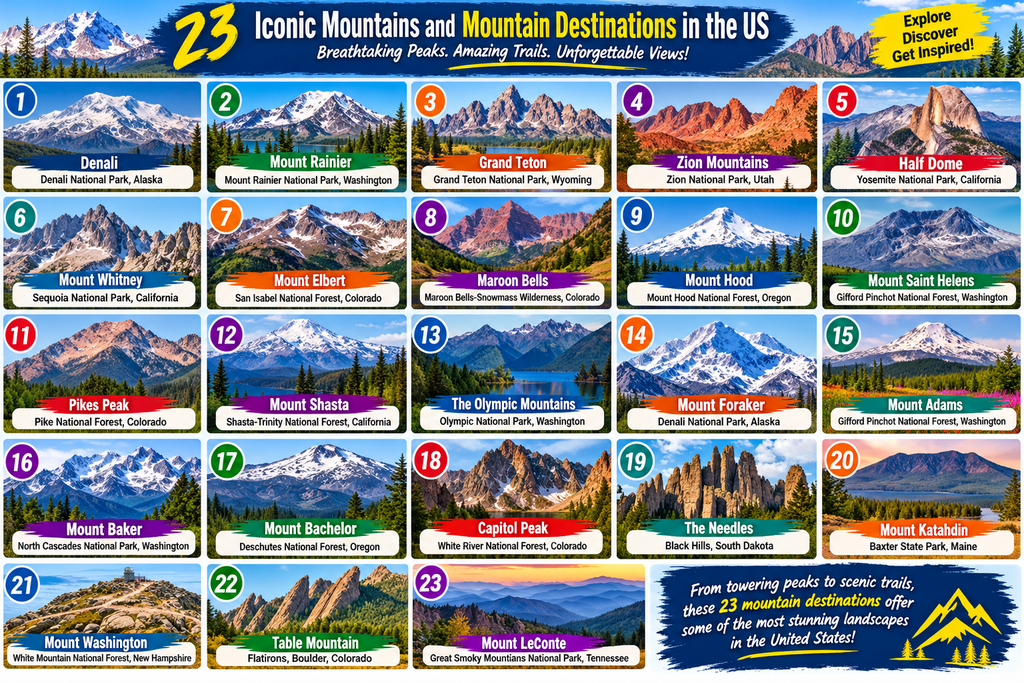
23 Iconic Mountains and Mountain Destinations in the US
Alaska
1. Denali, Alaska (about 20,310 ft). Denali is the highest mountain in North America, and it dominates the skyline of the surrounding national park on clear days. Most visitors see it by bus tour, short walks, or flightseeing, while climbing it is a serious multi-week expedition for experienced mountaineers. Clear views are never guaranteed, so plan extra days if seeing the summit matters to you. Learn more at Denali National Park.
Pacific Northwest
2. Mount Rainier, Washington (about 14,410 ft). Rainier is the most heavily glaciated peak in the lower 48 and a constant presence on the Seattle skyline. In July and August,t the meadows near Paradise fill with wildflowers, which makes it one of the most photogenic summer destinations in the country. Climbing the summit requires glacier skills, but the park’s trails suit most hikers. Check the Mount Rainier National Park page for road and entry updates.
3. Mount Hood, Oregon (about 11,240 ft). Oregon’s tallest peak sits close to Portland and is known for Timberline Lodge, glaciers, and skiing that stretches across much of the year. Visitors can enjoy it by scenic drive and lodge views, while climbers treat it as a classic snow climb that needs gear and condition awareness.
4. Mount Saint Helens, Washington (about 8,363 ft). Saint Helens erupted on May 18, 1980, and the landscape still tells that story. Today you can see the crater, lava flows, and regrowing forest from viewpoints and visitor centers, including Johnston Ridge Observatory on the north side. It is an excellent stop for families who like science and big scenery.
5. Mount Baker, Washington (about 10,781 ft). Baker, in the North Cascades, is one of the snowiest places in the country and a favorite of skiers and snowboarders. In summer, the trails near its base offer glacier views without requiring a climb.
6. Mount Adams, Washington (about 12,280 ft). The second-highest peak in Washington is a broad, glaciated volcano with a quieter reputation than Rainier. It rewards travelers who want big Cascade scenery with fewer crowds, and many people climb it on a long snow route in late spring or summer.
7. Mount Jefferson, Oregon (about 10,502 ft). Oregon’s second-highest peak is wrapped in wilderness, lakes, and forest. It is far less crowded than Hood, so it suits travelers who prefer solitude and can handle a longer approach.
8. Mount Olympus, Washington (about 7,980 ft). Olympus rises in Olympic National Park, where glaciers, temperate rainforest and rugged coastline sit within the same park. Most visitors enjoy the area from Hurricane Ridge viewpoints and the Hoh Rain Forest, while the mountain itself is a remote backcountry objective.
California
9. Mount Whitney, California (about 14,505 ft). Whitney is the highest peak in the contiguous US and the crown of the Sierra Nevada. The main trail is non-technical, but it is a very long day or a multi-day trip of roughly 22 miles round trip, and you need a permit. Allow time to adjust to altitude before you go. Permits are handled through Recreation.gov.
10. Mount Shasta, California (about 14,179 ft). Shasta rises alone above the landscape of Northern California, so it looks even taller than its height suggests. It is known for its snow cover, its volcanic shape, and its place in local legend, and it is a popular first snow climb for people building mountaineering skills.
11. Half Dome, California (about 8,839 ft). Half Dome is one of the most recognizable rock formations in the world. The hike to the summit is a demanding day of about 14 to 16 miles round trip, and the final cable section requires a permit. Many visitors skip the summit and still enjoy the views from Glacier Point and Yosemite Valley. See the Yosemite National Park page for permit rules.
Rockies and the Interior West
12. The Grand Teton, Wyoming (about 13,775 ft). The Teton Range rises almost straight out of Jackson Hole, with no foothills to soften the view. The Grand Teton itself is a technical alpine climb, but you can enjoy the scenery from Jenny Lake, Taggart Lake,e and the park’s viewpoints. See Grand Teton National Park for planning details.
13. Longs Peak, Colorado (about 14,259 ft). The signature peak of Rocky Mountain National Park is known for its sheer east face, called the Diamond. The standard Keyhole Route is a long, exposed scramble that demands an early start and good weather, so it is not a casual hike.
14. Mount Elbert, Colorado (about 14,440 ft). Elbert is the highest peak in the Rocky Mountains and the second-highest in the lower 48. Its standard routes are non-technical, which makes it one of the most approachable high-altitude summits, as long as you are fit, start early,rly and watch for afternoon storms.
15. Pikes Peak, Colorado (about 14,115 ft). America’s Mountain is easy to reach by the Pikes Peak Highway or, when it is operating, the cog railway, and it can also be hiked via the long Barr Trail. The view helped inspire Katharine Lee Bates to write America the Beautiful in 1893.
16. Glacier National Park, Montana. Often called the Crown of the Continent, Glacier is a landscape of jagged peaks, glacial valleys, and turquoise lakes. Going-to-the-Sun Road is the star attraction, though it is seasonal and can require planning, so confirm access on the Glacier National Park website before you go. Mountain goats and grizzlies live here, so carry bear spray and know how to use it.
Southwest and Utah
17. Humphreys Peak, Arizona (about 12,633 ft). The highest point in Arizona rises above Flagstaff in the San Francisco Peaks. The trail is non-technical, roughly 10 miles round trip, and surprises many desert travelers with its alpine scenery and weather.
18. West Temple, Utah (about 7,810 ft). This towering sandstone peak is one of the landmark features of Zion National Park. You do not need to climb it to enjoy it, since the red and white cliffs are visible from the canyon road and many of the park’s trails.
19. Kings Peak, Utah (about 13,528 ft). Utah’s highest point lies in the Uinta Mountains and is usually reached as a multi-day backpacking trip. It suits experienced hikers who enjoy wilderness travel more than crowds.
The East
20. Mount Washington, New Hampshire (about 6,288 ft). Washington is modest in height but famous for some of the worst weather in the world, including a recorded wind gust of 231 miles per hour in 1934. You can reach the summit on foot, by car, or by the cog railway, but conditions can change fast, so check the forecast and carry extra layers even in summer.
21. Mount Katahdin, Maine (about 5,269 ft). Katahdin is the northern end of the Appalachian Trail and the high point of Baxter State Park. The Knife Edge ridge is exposed and not suited to everyone, so choose your route with care and check the park’s rules and parking reservations before you go.
22. Mount Mitchell, North Carolina (about 6,684 ft). Mitchell is the highest peak east of the Mississippi River. You can reach the summit area by road and a short walk, or earn it on a steep trail through the Blue Ridge Mountains.
Hawaii
23. Mauna Kea, Hawaii (about 13,800 ft). Measured from its base on the ocean floor, Mauna Kea is the tallest mountain on Earth, at more than 30,000 feet. The summit holds major astronomical observatories and is sacred in Native Hawaiian culture, so visit respectfully and check current access rules. Altitude is a real issue here, so rest at the visitor information station before going higher.
Best Mountains for Families and Beginners
You do not need to summit anything to enjoy the mountains. These options are the easiest starting points for families:
- Great Smoky Mountains National Park: Short waterfall walks, wildlife, and scenic drives.
- Rocky Mountain National Park: Alpine lakes and easy trails near Estes Park, plus a popular Junior Ranger program.
- Mount Rainier (Paradise area): Wildflower meadows and short loops in summer.
- Grand Teton National Park: Boat shuttle and easy lakeside trails at Jenny Lake.
- Glacier National Park: Scenic drives and short trails around the lakes.
- Pikes Peak and Mount Mitchell: Summit views with minimal hiking.
If you are planning with young kids, our guides to hiking with kids, family-friendly hikes, and the Junior Ranger program can help you choose trails and keep children engaged. You can also compare options in our list of the best national parks for families with young kids.
Best Time to Visit US Mountains
- Summer (June to September): The best window for most western peak hiking trails, and scenic. Expect afternoon thunderstorms in the Rockies and busy parks.
- Fall (September to October): Ideal for the Appalachians, the Smokies, es and the White Mountains, where leaf color peaks. Western high roads may begin closing.
- Winter (December to March): Best for skiing and snow scenery in the Cascades, Sierra Nevada, and Rockies. Many high roads and trails are closed or require winter skills.
- Spring (April to June): Waterfalls run full, but snow can linger at elevation and some roads open late.
For help timing a trip, see our guide to the best time to visit national parks with kids.
How to Choose the Right Mountain for Your Trip
- Decide your goal. Scenery, a family outing, a hike, or a serious climb each points to different places.
- Be honest about experience. A walk to a viewpoint and a glacier climb are very different. Choose terrain that matches the least experienced person in your group.
- Check elevation. Altitude sickness can affect people above roughly 8,000 feet. Arrive early, drink water,r and go slowly.
- Check permits and reservations. Half Dome and some parks require permits or timed entry, and they can sell out.
- Plan around weather. Mountain weather changes quickly, even in summer.
- Have a backup. If conditions are poor, a lower trail or scenic drive can still make the day.
Mountain Safety Basics
- Check the forecast and the official park page for closures before you leave.
- Start early, especially at altitude, to avoid afternoon storms.
- Carry water, snacks, layers, sun protection, and a headlamp.
- Tell someone your route and return time.
- Keep your distance from wildlife and carry bear spray where recommended.
- Turn back if the weather, the terrain,n or the kids’ energy say it is time.
- Follow Leave No Trace principles to protect fragile alpine areas.
For more family-focused advice, read our family travel safety tips.
Frequently Asked Questions
What is the highest mountain in the US?
Denali in Alaska is the highest mountain in the US and in North America, at about 20,310 feet.
What is the highest mountain in the lower 48 states?
Mount Whitney in California is the highest peak in the contiguous US, at about 14,505 feet.
What are the most beautiful mountains in the US?
Beauty is subjective, but the Grand Tetons, Glacier National Park, Mount Rainier,t he Sierra Nevada, da and the Great Smoky Mountains are among the most photographed and most loved.
What is the most visited mountain range in the US?
The Great Smoky Mountains are part of the most visited national park in the country, which makes them one of the busiest mountain destinations.
Which US mountains are best for beginners?
The Smokies, Rocky Mountain National Park, the Paradise area of Mount Rai,,nier and the Jenny Lake area of Grand Teton offer easy trails and viewpoints. Mount Elbert and Pikes Peak are non-technical high summits for fit hikers.
Which mountains can you drive up?
Pikes Peak, Mount Washington,n and Mount Mitchell have roads to or near the summit, though conditions and rules vary by season.
When is the best time to visit the mountains in the US?
Summer is best for most western peaks, while fall is ideal for the Appalachians. Winter suits skiers and snow lovers.
Do you need permits to visit US mountains?
Some do. Mount Whitney and Half Dome require permits, and several parks use timed entry or reservations. Always check the official website before you go.
Final Thoughts
The best mountains in the US are the ones that match your goals, your fitness, and your travel style. A family might fall in love with the misty Smokies, a hiker might train for Whitney, and a photographer might chase Rainier’s wildflowers or the Tetons at sunrise. Start with a range, pick one or two places, and leave room for weather and curiosity.
Ready to plan your next trip? Browse our guide to the best national parks for families with young kids or start with beginner-friendly hiking with kids tips.